Outcomes in ST-segment elevation myocardial infarction treated with primary percutaneous coronary intervention or pharmacoinvasive strategy in a Latin American country
| dc.contributor.author | Chacón-Diaz, M. | |
| dc.contributor.author | Custodio-Sánchez, P. | |
| dc.contributor.author | Rojas De la Cuba, P. | |
| dc.contributor.author | Yábar-Galindo, G. | |
| dc.contributor.author | Rodríguez-Olivares, R. | |
| dc.contributor.author | Miranda-Noé, D. | |
| dc.contributor.author | López-Rojas, L.M. | |
| dc.contributor.author | Hernández-Vásquez, A. | |
| dc.date.accessioned | 2025-10-31T18:33:25Z | |
| dc.date.available | 2025-10-31T18:33:25Z | |
| dc.date.issued | 2022 | |
| dc.identifier.uri | https://hdl.handle.net/20.500.12805/4936 | |
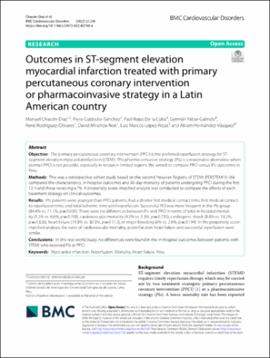
| dc.description.abstract | Objective: The primary percutaneous coronary intervention (PPCI) is the preferred reperfusion strategy for ST-segment elevation myocardial infarction (STEMI). The pharmacoinvasive strategy (PIs) is a reasonable alternative when prompt PPCI is not possible, especially in resource-limited regions. We aimed to compare PPCI versus PIs outcomes in Peru. Methods: This was a retrospective cohort study based on the second Peruvian Registry of STEMI (PERSTEMI II). We compared the characteristics, in-hospital outcomes and 30-day mortality of patients undergoing PPCI during the first 12 h and those receiving a PIs. A propensity score-matched analysis was conducted to compare the effects of each treatment strategy on clinical outcomes. Results: PIs patients were younger than PPCI patients, had a shorter first medical contact time, first medical contact to reperfusion time, and total ischemic time until reperfusion. Successful PCI was more frequent in the PIs group (84.4% vs. 71.1%, p = 0.035). There were no differences between PIs and PPCI in terms of total in-hospital mortality (5.2% vs. 6.6%, p = 0.703), cardiovascular mortality (4.2% vs. 5.3%, p = 0.735), cardiogenic shock (8.3% vs. 13.2%, p = 0.326), heart failure (19.8% vs. 30.3%, p = 0.112), or major bleeding (0% vs. 2.6%, p = 0.194). In the propensity score-matched analysis, the rates of cardiovascular mortality, postinfarction heart failure and successful reperfusion were similar. Conclusions: In this real-world study, no differences were found in the in-hospital outcomes between patients with STEMI who received PIs or PPCI. | en_US |
| dc.description.sponsorship | We very much appreciate the work of all the health care staff who assisted in the current study. | |
| dc.format | application/pdf | |
| dc.language.iso | eng | |
| dc.publisher | BioMed Central | |
| dc.relation.ispartof | urn:issn:1471-2261 | |
| dc.rights | https://purl.org/coar/access_right/c_abf2 | |
| dc.rights.uri | https://creativecommons.org/licenses/by-nc-sa/4.0/ | |
| dc.subject | SDG 3 | en_US |
| dc.subject | Thrombolytic Strategies in Myocardial Infarction Management | en_US |
| dc.subject | Timely Management of ST Segment Elevation Myocardial Infarction | en_US |
| dc.title | Outcomes in ST-segment elevation myocardial infarction treated with primary percutaneous coronary intervention or pharmacoinvasive strategy in a Latin American country | en_US |
| dc.type | https://purl.org/coar/resource_type/c_2df8fbb1 | |
| dc.identifier.doi | https://doi.org/10.1186/s12872-022-02730-6 | |
| dc.subject.ocde | https://purl.org/pe-repo/ocde/ford#3.02.04 | |
| dc.type.other | Research article | |
| dc.identifier.journal | BMC Cardiovascular Disorders | |
| dc.type.version | https://purl.org/coar/version/c_970fb48d4fbd8a85 |
Files in this item
This item appears in the following Collection(s)
-
Artículos de Investigación [1294]

Except where otherwise noted, this item's license is described as https://purl.org/coar/access_right/c_abf2