COVID-19 vaccine hesitancy and emerging variants: Evidence from six countries
| dc.contributor.author | Mangla, S. | |
| dc.contributor.author | Zohra Makkia, F.T. | |
| dc.contributor.author | Pathak, A.K. | |
| dc.contributor.author | Robinson, R. | |
| dc.contributor.author | Sultana, N. | |
| dc.contributor.author | Koonisetty, K.S. | |
| dc.contributor.author | Karamehic-Muratovic, A. | |
| dc.contributor.author | Nguyen, U.-S.D.T. | |
| dc.contributor.author | Rodriguez-Morales, A.J. | |
| dc.contributor.author | Sanchez-Duque, J.A. | |
| dc.contributor.author | Zamba, P.T. | |
| dc.contributor.author | Aghamohammadi, N. | |
| dc.contributor.author | Cs, F. | |
| dc.contributor.author | Haque, U. | |
| dc.date.accessioned | 2025-10-31T18:33:21Z | |
| dc.date.available | 2025-10-31T18:33:21Z | |
| dc.date.issued | 2021 | |
| dc.identifier.uri | https://hdl.handle.net/20.500.12805/4922 | |
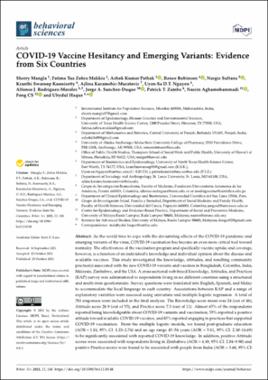
| dc.description.abstract | As the world tries to cope with the devastating effects of the COVID-19 pandemic and emerging variants of the virus, COVID-19 vaccination has become an even more critical tool toward normalcy. The effectiveness of the vaccination program and specifically vaccine uptake and coverage, however, is a function of an individual’s knowledge and individual opinion about the disease and available vaccines. This study investigated the knowledge, attitudes, and resulting community practice(s) associated with the new COVID-19 variants and vaccines in Bangladesh, Colombia, India, Malaysia, Zimbabwe, and the USA. A cross-sectional web-based Knowledge, Attitudes, and Practices (KAP) survey was administered to respondents living in six different countries using a structured and multi-item questionnaire. Survey questions were translated into English, Spanish, and Malay to accommodate the local language in each country. Associations between KAP and a range of explanatory variables were assessed using univariate and multiple logistic regression. A total of 781 responses were included in the final analysis. The Knowledge score mean was 24 (out of 46), Attitude score 28.9 (out of 55), and Practice score 7.3 (out of 11). Almost 65% of the respondents reported being knowledgeable about COVID-19 variants and vaccination, 55% reported a positive attitude toward available COVID-19 vaccines, and 85% reported engaging in practices that supported COVID-19 vaccination. From the multiple logistic models, we found post-graduate education (AOR = 1.83, 95% CI: 1.23–2.74) and an age range 45–54 years (AOR = 5.81, 95% CI: 2.30–14.69) to be significantly associated with reported COVID-19 knowledge. In addition, positive Attitude scores were associated with respondents living in Zimbabwe (AOR = 4.49, 95% CI: 2.04–9.90) and positive Practice scores were found to be associated with people from India (AOR = 3.68, 95% CI: 1.15–11.74) and high school education (AOR = 2.16, 95% CI: 1.07–4.38). This study contributes to the identification of socio-demographic factors associated with poor knowledge, attitudes, and practices relating to COVID-19 variants and vaccines. It presents an opportunity for collaboration with diverse communities to address COVID-19 misinformation and common sources of vaccine hesitancy (i.e., knowledge, attitudes, and practices). | en_US |
| dc.description.sponsorship | Funding: UH was supported by the Research Council of Norway (Grant # 281077). | |
| dc.format | application/pdf | |
| dc.language.iso | eng | |
| dc.publisher | MDPI | |
| dc.relation.ispartof | urn:issn:2076-328X | |
| dc.rights | https://purl.org/coar/access_right/c_abf2 | |
| dc.rights.uri | https://creativecommons.org/licenses/by-nc-sa/4.0/ | |
| dc.subject | SDG 3 | en_US |
| dc.subject | COVID-19, Its Impact, and Vaccination | en_US |
| dc.subject | Vaccine Acceptance and Hesitancy Dynamics | en_US |
| dc.title | COVID-19 vaccine hesitancy and emerging variants: Evidence from six countries | en_US |
| dc.type | https://purl.org/coar/resource_type/c_2df8fbb1 | |
| dc.identifier.doi | https://doi.org/10.3390/bs11110148 | |
| dc.subject.ocde | https://purl.org/pe-repo/ocde/ford#1.02.02 | |
| dc.type.other | Research article | |
| dc.identifier.journal | Behavioral Sciences | |
| dc.type.version | https://purl.org/coar/version/c_970fb48d4fbd8a85 |
Files in this item
This item appears in the following Collection(s)
-
Artículos de Investigación [1294]

Except where otherwise noted, this item's license is described as https://purl.org/coar/access_right/c_abf2