Checklist of chewing lice (Phthiraptera: Amblycera and ischnocera) on birds of Peru
| dc.contributor.author | Minaya, D. | |
| dc.contributor.author | Príncipe, F. | |
| dc.contributor.author | Iannacone, J. | |
| dc.date.accessioned | 2025-10-31T18:33:18Z | |
| dc.date.available | 2025-10-31T18:33:18Z | |
| dc.date.issued | 2021 | |
| dc.identifier.uri | https://hdl.handle.net/20.500.12805/4911 | |
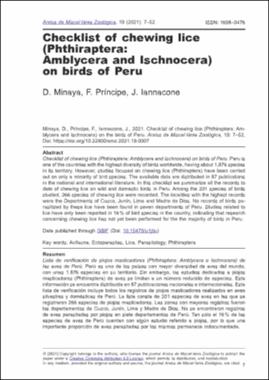
| dc.description.abstract | Peru is one of the countries with the highest diversity of birds worldwide, having about 1,876 species in its territory. However, studies focused on chewing lice (Phthiraptera) have been carried out on only a minority of bird species. The available data are distributed in 87 publications in the national and international literature. In this checklist we summarize all the records to date of chewing lice on wild and domestic birds in Peru. Among the 301 species of birds studied, 266 species of chewing lice were recorded. The localities with the highest records were the Departments of Cusco, Junín, Lima and Madre de Dios. No records of birds pa-rasitized by these lice have been found in seven departments of Peru. Studies related to lice have only been reported in 16 % of bird species in the country, indicating that research concerning chewing lice has not yet been performed for the the majority of birds in Peru. | en_US |
| dc.description.abstract | Perú es uno de los países con mayor diversidad de aves del mundo, con unas 1.876 especies en su territorio. Sin embargo, los estudios dedicados a piojos masticadores (Phthiraptera) de aves se limitan a un número reducido de especies. Esta información se encuentra distribuida en 87 publicaciones nacionales e internacionales. Esta lista de verificación incluye todos los registros de piojos masticadores realizados en aves silvestres y domésticas de Perú. La lista consta de 301 especies de aves en las que se registraron 266 especies de piojos masticadores. Las zonas con mayores registros fueron los departamentos de Cuzco, Junín, Lima y Madre de Dios. No se encontraron registros de aves parasitadas por piojos en siete departamentos de Perú. Tan solo el 16% de las especies de aves de Perú cuentan con algún estudio referido a piojos, por lo que una importante proporción de aves parasitadas por los mismos permanece indocumentada. | es_PE |
| dc.format | application/pdf | |
| dc.language.iso | eng | |
| dc.publisher | Museu de Ciencies Naturals | |
| dc.relation.ispartof | urn:issn:1698-0476 | |
| dc.rights | https://purl.org/coar/access_right/c_abf2 | |
| dc.rights.uri | https://creativecommons.org/licenses/by-nc-sa/4.0/ | |
| dc.subject | Parasite Dynamics in Freshwater Eel Populations | en_US |
| dc.subject | Diversity and Ecology of Avian Chewing Lice | en_US |
| dc.title | Checklist of chewing lice (Phthiraptera: Amblycera and ischnocera) on birds of Peru | en_US |
| dc.title.alternative | Lista de verificación de piojos masticadores (Phthiraptera: Amblycera e Ischnocera) de las aves de Perú. | es_PE |
| dc.type | https://purl.org/coar/resource_type/c_2df8fbb1 | |
| dc.identifier.doi | https://doi.org/10.32800/amz.2021.19.0007 | |
| dc.subject.ocde | https://purl.org/pe-repo/ocde/ford#1.06.11 | |
| dc.type.other | Research article | |
| dc.identifier.journal | Arxius de Miscellania Zoologica | |
| dc.type.version | https://purl.org/coar/version/c_970fb48d4fbd8a85 |
Files in this item
This item appears in the following Collection(s)
-
Artículos de Investigación [1294]

Except where otherwise noted, this item's license is described as https://purl.org/coar/access_right/c_abf2