The relative importance of soil properties and regional climate as drivers of productivity in southern Patagonia’s Nothofagus antarctica forests
| dc.contributor.author | Bahamonde, H.A. | |
| dc.contributor.author | Pastur, G.M. | |
| dc.contributor.author | Lencinas, M.V. | |
| dc.contributor.author | Soler, R. | |
| dc.contributor.author | Rosas, Y.M. | |
| dc.contributor.author | Ladd, B. | |
| dc.contributor.author | Guardia, S.D. | |
| dc.contributor.author | Peri, P.L. | |
| dc.date.accessioned | 2025-10-31T18:33:11Z | |
| dc.date.available | 2025-10-31T18:33:11Z | |
| dc.date.issued | 2018 | |
| dc.identifier.uri | https://hdl.handle.net/20.500.12805/4882 | |
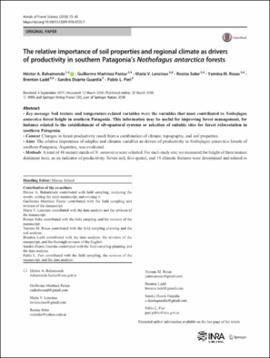
| dc.description.abstract | Key message: Soil texture and temperature-related variables were the variables that most contributed toNothofagus antarcticaforest height in southern Patagonia. This information may be useful for improving forest management, for instance related to the establishment of silvopastoral systems or selection of suitable sites for forest reforestation in southern Patagonia. Context: Changes in forest productivity result from a combination of climate, topography, and soil properties. Aims: The relative importance of edaphic and climatic variables as drivers of productivity in Nothofagus antarctica forests of southern Patagonia, Argentina, was evaluated. Methods: A total of 48 mature stands of N. antarctica were selected. For each study site, we measured the height of three mature dominant trees, as an indicator of productivity. Seven soil, five spatial, and 19 climatic features were determined and related to forest productivity. Through partial least squares regression analyses, we obtained a model that was an effective predictor of height of mature dominant trees in the regional data set presented here. Results: The four variables that most contributed to the predictive power of the model were altitude, temperature annual range, soil texture, and temperature seasonality. Conclusion: The information gathered in this study suggested that the incidence of the soil and temperature-related variables on the height of dominant trees, at the regionally evaluated scale, was higher than the effect of water-related variables. | en_US |
| dc.description.sponsorship | Funding text 1: This research has been partially financed by Instituto Nacional de Tecnología Agropecuaria (INTA) and Consejo Nacional de Investigaciones Científicas y Técnicas (CONICET), Argentina.; Funding text 2: Data availability This study was financed by CONICET (Argentinean National Research Council) project. According to their specifications, at the end of the project and after | |
| dc.format | application/pdf | |
| dc.language.iso | eng | |
| dc.publisher | Springer-Verlag France | |
| dc.relation.ispartof | urn:issn:1286-4560 | |
| dc.rights | https://purl.org/coar/access_right/c_abf2 | |
| dc.rights.uri | https://creativecommons.org/licenses/by-nc-sa/4.0/ | |
| dc.subject | SDG 2 | en_US |
| dc.subject | SDG 12 | en_US |
| dc.subject | SDG 15 | en_US |
| dc.subject | Invasive Species Management and Plant Community Dynamics | en_US |
| dc.subject | Nothofagus Forests and Their Ecological Dynamics | en_US |
| dc.title | The relative importance of soil properties and regional climate as drivers of productivity in southern Patagonia’s Nothofagus antarctica forests | en_US |
| dc.type | https://purl.org/coar/resource_type/c_2df8fbb1 | |
| dc.identifier.doi | https://doi.org/10.1007/s13595-018-0725-7 | |
| dc.subject.ocde | https://purl.org/pe-repo/ocde/ford#1.06.13 | |
| dc.type.other | Research article | |
| dc.identifier.journal | Annals of Forest Science | |
| dc.type.version | https://purl.org/coar/version/c_970fb48d4fbd8a85 |
Files in this item
This item appears in the following Collection(s)
-
Artículos de Investigación [1294]

Except where otherwise noted, this item's license is described as https://purl.org/coar/access_right/c_abf2