Evaluation of a functional assessment tool in patients with mild cognitive impairment or Alzheimer’s disease in Lima, Peru
| dc.contributor.author | Custodio, N. | |
| dc.contributor.author | Montesinos, R. | |
| dc.contributor.author | Chambergo-Michilot, D. | |
| dc.contributor.author | Herrera-Perez, E. | |
| dc.contributor.author | Caipa, M.P. | |
| dc.contributor.author | Seminario G, W. | |
| dc.contributor.author | Cuenca, J. | |
| dc.contributor.author | Mesia, L. | |
| dc.contributor.author | Failoc-Rojas, V.E. | |
| dc.contributor.author | Diaz, M.M. | |
| dc.date.accessioned | 2025-10-31T18:33:03Z | |
| dc.date.available | 2025-10-31T18:33:03Z | |
| dc.date.issued | 2022 | |
| dc.identifier.uri | https://hdl.handle.net/20.500.12805/4848 | |
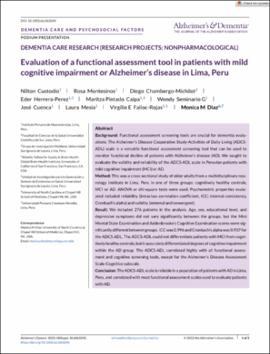
| dc.description.abstract | Background: Functional assessment screening tools are crucial for dementia evaluations. The Alzheimer’s Disease Cooperative Study-Activities of Daily Living (ADCS-ADL) scale is a versatile functional assessment screening tool that can be used to monitor functional decline of patients with Alzheimer’s disease (AD). We sought to evaluate the validity and reliability of the ADCS-ADL scale in Peruvian patients with mild cognitive impairment (MCI) or AD. Method: This was a cross-sectional study of older adults from a multidisciplinary neurology institute in Lima, Peru in one of three groups: cognitively healthy controls, MCI or AD. ANOVA or chi-square tests were used. Psychometric properties evaluated included reliability (intraclass correlation coefficient, ICC; internal consistency, Cronbach’s alpha) and validity (external and convergent). Result: We included 276 patients in the analysis. Age, sex, educational level, and depressive symptoms did not vary significantly between the groups, but the Mini Mental State Examination and Addenbrooke’s Cognitive Examination scores were significantly different between groups. ICC was 0.996 and Cronbach’s alpha was 0.937 for the ADCS-ADL. The ADCS-ADL could not differentiate patients with MCI from cognitively healthy controls, but it accurately differentiated degrees of cognitive impairment within the AD group. The ADCS-ADL correlated highly with all functional assessment and cognitive screening tools, except for the Alzheimer’s Disease Assessment Scale-Cognitive subscale. Conclusion: The ADCS-ADL scale is reliable in a population of patients with AD in Lima, Peru, and correlated with most functional assessment scales used to evaluate patients with AD. | en_US |
| dc.format | application/pdf | |
| dc.language.iso | eng | |
| dc.publisher | John Wiley and Sons | |
| dc.relation.ispartof | urn:issn:1552-5279 | |
| dc.rights | https://purl.org/coar/access_right/c_abf2 | |
| dc.rights.uri | https://creativecommons.org/licenses/by-nc-sa/4.0/ | |
| dc.subject | Cognitive Impairment and Neuroimaging in Alzheimer's Disease | en_US |
| dc.subject | Cognitive Function and Daily Living in Dementia | en_US |
| dc.title | Evaluation of a functional assessment tool in patients with mild cognitive impairment or Alzheimer’s disease in Lima, Peru | en_US |
| dc.type | https://purl.org/coar/resource_type/c_2df8fbb1 | |
| dc.identifier.doi | https://doi.org/10.1002/alz.063245 | |
| dc.subject.ocde | https://purl.org/pe-repo/ocde/ford#3.02.25 | |
| dc.type.other | Research article | |
| dc.identifier.journal | Alzheimer's and Dementia | |
| dc.type.version | https://purl.org/coar/version/c_970fb48d4fbd8a85 |
Files in this item
This item appears in the following Collection(s)
-
Artículos de Investigación [1294]

Except where otherwise noted, this item's license is described as https://purl.org/coar/access_right/c_abf2