Efficiency of microalgae cultures for nutrient removal from domestic wastewater
| dc.contributor.author | Ponte, W.M.L. | |
| dc.contributor.author | Talaverano, N.Z. | |
| dc.contributor.author | Huaynate, A.O. | |
| dc.contributor.author | Cafferata, E.A. | |
| dc.contributor.author | Gallegos, M.C. | |
| dc.date.accessioned | 2025-10-31T18:33:01Z | |
| dc.date.available | 2025-10-31T18:33:01Z | |
| dc.date.issued | 2022 | |
| dc.identifier.uri | https://hdl.handle.net/20.500.12805/4840 | |
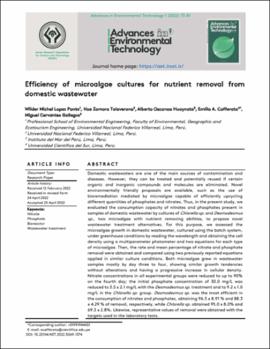
| dc.description.abstract | Domestic wastewaters are one of the main sources of contamination and diseases. However, they can be treated and potentially reused if certain organic and inorganic compounds and molecules are eliminated. Novel environmentally friendly proposals are available, such as the use of bioremediation mediated by microalgae capable of efficiently upcycling different quantities of phosphates and nitrates. Thus, in the present study, we evaluated the consumption capacity of nitrates and phosphates present in samples of domestic wastewater by cultures of Chlorella sp. and Desmodesmus sp., two microalgae with nutrient removing abilities, to propose novel wastewater treatment alternatives. For this purpose, we assessed the microalgae growth in domestic wastewater, cultured using the batch system, under greenhouse conditions by reading the wavelength and obtaining the cell density using a multiparameter photometer and two equations for each type of microalgae. Then, the rate and mean percentage of nitrate and phosphate removal were obtained and compared using two previously reported equations applied in similar culture conditions. Both microalgae grew in wastewater samples mostly by day three to four, showing similar growth tendencies without alterations and having a progressive increase in cellular density. Nitrate concentrations in all experimental groups were reduced to up to 90% on the fourth day; the initial phosphate concentration of 30.0 mg/L was reduced to 3.5 ± 2.1 mg/L with the Desmodesmus sp. treatment and to 9.2 ± 1.0 mg/L in the Chlorella sp. group. Desmodesmus sp. was the most efficient in the consumption of nitrates and phosphates, obtaining 96.5 ± 8.91 % and 88.3 ± 4.29 % of removal, respectively, while Chlorella sp. obtained 95.0 ± 8.0% and 69.3 ± 2.8%. Likewise, representative values of removal were obtained with the targets used in the laboratory tests. | en_US |
| dc.format | application/pdf | |
| dc.language.iso | eng | |
| dc.publisher | Iranian Research Organization for Science and Technology | |
| dc.relation.ispartof | urn:issn:2476-4779 | |
| dc.rights | https://purl.org/coar/access_right/c_abf2 | |
| dc.rights.uri | https://creativecommons.org/licenses/by-nc-sa/4.0/ | |
| dc.subject | SDG 3 | en_US |
| dc.subject | SDG 6 | en_US |
| dc.subject | SDG 15 | en_US |
| dc.subject | Microalgae Utilization for Lipid Production and Wastewater Treatment | en_US |
| dc.subject | Microalgae Utilization in Wastewater Treatment Systems | en_US |
| dc.title | Efficiency of microalgae cultures for nutrient removal from domestic wastewater | en_US |
| dc.type | https://purl.org/coar/resource_type/c_2df8fbb1 | |
| dc.identifier.doi | https://doi.org/10.22104/aet.2022.5069.1374 | |
| dc.subject.ocde | https://purl.org/pe-repo/ocde/ford#2.07.01 | |
| dc.type.other | Research article | |
| dc.identifier.journal | Advances in Environmental Technology | |
| dc.type.version | https://purl.org/coar/version/c_970fb48d4fbd8a85 |
Files in this item
This item appears in the following Collection(s)
-
Artículos de Investigación [1294]

Except where otherwise noted, this item's license is described as https://purl.org/coar/access_right/c_abf2