Late myocardial reperfusion in ST-elevation myocardial infarction: Protocol for a systematic review and meta-analysis
| dc.contributor.author | Vargas-Fernández, R | |
| dc.contributor.author | Chacón-Diaz, M. | |
| dc.contributor.author | Basualdo-Meléndez, G.W. | |
| dc.contributor.author | Barón-Lozada, F.A. | |
| dc.contributor.author | Visconti-Lopez, F.J. | |
| dc.contributor.author | Comandé, D. | |
| dc.contributor.author | Hernández-Vásquez, A. | |
| dc.date.accessioned | 2025-10-31T18:32:56Z | |
| dc.date.available | 2025-10-31T18:32:56Z | |
| dc.date.issued | 2022 | |
| dc.identifier.uri | https://hdl.handle.net/20.500.12805/4816 | |
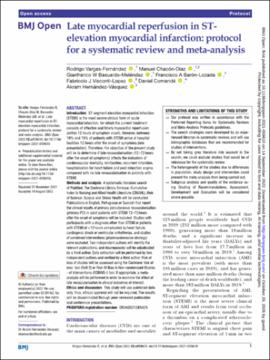
| dc.description.abstract | Introduction ST-segment elevation myocardial infarction (STEMI) is the most severe clinical form of acute myocardial infarction, for which the current treatment consists of effective and timely myocardial reperfusion (within 12 hours of symptom onset). However, between 10% and 15% of patients with STEMI arrive at hospital facilities 12 hours after the onset of symptoms (late presentation). Therefore, the objective of the present study will be to determine if late revascularisation (12-72 hours after the onset of symptoms) affects the indicators of cardiovascular mortality, reinfarction, recurrent infarction, hospitalisation for heart failure and post infarction angina compared with no late revascularisation in patients with STEMI. Methods and analysis A systematic literature search of PubMed, The Cochrane Library, Embase, Cumulative Index to Nursing and Allied Health Literature (CINAHL), Web of Science, Scopus and Global Health will be conducted. Publications in English, Portuguese or Spanish that report the clinical results of primary percutaneous revascularisation (primary PCI) in adult patients with STEMI 12-72 hours after the onset of symptoms will be included. Studies with participants with a diagnosis other than STEMI or patients with STEMI of >12 hours complicated by heart failure, cardiogenic shock or ventricular arrhythmias, and studies of combined interventions (pharmacoinvasive strategy) were excluded. Two independent authors will identify the relevant publications, and discrepancies will be adjudicated by a third author. Data extraction will be performed by two independent authors and verified by a third author. Risk of bias of studies will be assessed using the Cochrane risk of bias' tool (RoB 2) or Risk Of Bias In Non-randomised Studies - of Interventions (ROBINS-I) tool. If appropriate, a meta-analysis will be performed in order to examine the effect of late revascularisation in clinical outcomes of interest. Ethics and discussion This study will use published data only, thus, ethical approval will not be required. The results will be disseminated through peer-reviewed publication and conference presentations. PROSPERO registration number CRD42021283429. | en_US |
| dc.format | application/pdf | |
| dc.language.iso | eng | |
| dc.publisher | BMJ Publishing Group | |
| dc.relation.ispartof | urn:issn:2044-6055 | |
| dc.rights | https://purl.org/coar/access_right/c_abf2 | |
| dc.rights.uri | https://creativecommons.org/licenses/by-nc-sa/4.0/ | |
| dc.subject | SDG 3 | en_US |
| dc.subject | Thrombolytic Strategies in Myocardial Infarction Management | en_US |
| dc.subject | Timely Management of ST Segment Elevation Myocardial Infarction | en_US |
| dc.title | Late myocardial reperfusion in ST-elevation myocardial infarction: Protocol for a systematic review and meta-analysis | en_US |
| dc.type | https://purl.org/coar/resource_type/DX5J-TA9R | |
| dc.identifier.doi | https://doi.org/10.1136/bmjopen-2021-059610 | |
| dc.subject.ocde | https://purl.org/pe-repo/ocde/ford#3.02.04 | |
| dc.type.other | Protocolo | |
| dc.identifier.journal | BMJ Open | |
| dc.type.version | https://purl.org/coar/version/c_970fb48d4fbd8a85 |
Files in this item
This item appears in the following Collection(s)
-
Artículos de Revisión [256]

Except where otherwise noted, this item's license is described as https://purl.org/coar/access_right/c_abf2