Relación entre los niveles de autoeficacia y disposición para realizar una tesis en estudiantes peruanos de Odontología
| dc.contributor.author | Castro Rodríguez, Y. | |
| dc.contributor.author | Castillo Quispe, S. | |
| dc.date.accessioned | 2025-10-31T18:32:30Z | |
| dc.date.available | 2025-10-31T18:32:30Z | |
| dc.date.issued | 2023 | |
| dc.identifier.uri | https://revestomatologia.sld.cu/index.php/est/article/view/3699 | |
| dc.identifier.uri | https://hdl.handle.net/20.500.12805/4673 | |
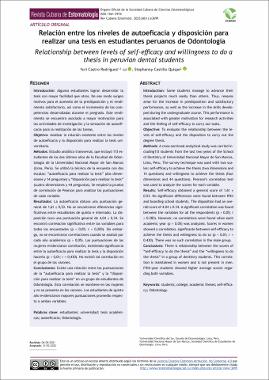
| dc.description.abstract | Introduction: Some students manage to advance their thesis projects much easily than others. Thus, reasons arise for the increase in predisposition and satisfactory performance, as well as the increase in the skills develo-ped during the undergraduate course. This performance is associated with greater motivation for research activities and the feeling of self-efficacy to carry out tasks. Objective: To evaluate the relationship between the levels of self-efficacy and the disposition to carry out the degree thesis. Methods: A cross-sectional analytical study was carried in-cluding113 students from the last two years of the School of Dentistry of Universidad Nacional Mayor de San Marcos, Lima, Peru. The survey technique was used with two sca-les: self-efficacy to achieve the thesis (two dimensions and 14 questions) and willingness to achieve the thesis (four dimensions and 44 questions). Pearson’s correlation test was used to analyze the scores for each variable. Results: Self-efficacy obtained a general score of 1.61 ± 0.53. No significant differences were found between fifth and boarding school students. The disposition had an ove-rall score of 4.04 ± 0.34. A significant correlation was found between the variables for all the respondents (p < 0.05; r = 0.283). However, no correlations were found when each academic year (p > 0.05) was analyzed. Scores in women showed a correlation, significante between self-efficacy to achieve the thesis and willingness to do so (p < 0.01; r = 0.430). There was no such correlation in the male group. Conclusions: There is relationship between the scores of “self-efficacy to do the thesis” and the “willingness to do the thesis” in a group of dentistry students. This correlation is maintained in women and is not present in men. Fifth-year students showed higher average scores regar-ding both variables. | en_US |
| dc.description.abstract | Introducción: Algunos estudiantes logran desarrollar la tesis con mayor facilidad que otros. De ese modo surgen motivos para el aumento de la predisposición y el rendi-miento satisfactorio, así como el incremento de las com-petencias desarrolladas durante el pregrado. Este rendi-miento se encuentra asociado a mayor motivación para las actividades de investigación y la sensación de autoefi-cacia para la realización de las tareas.Objetivo: Analizar la relación existente entre los niveles de autoeficacia y la disposición para realizar la tesis uni-versitaria. Métodos: Estudio analítico transversal, que incluyó 113 es-tudiantes de los dos últimos años de la Facultad de Odon-tología de la Universidad Nacional Mayor de San Marcos (Lima, Perú). Se utilizó la técnica de la encuesta con dos escalas: “autoeficacia para realizar la tesis” (dos dimen-siones y 14 preguntas) y “disposición para realizar la tesis” (cuatro dimensiones y 44 preguntas). Se empleó la prueba de correlación de Pearson para analizar las puntuaciones de cada variable. Resultados: La autoeficacia obtuvo una puntuación ge-neral de 1,61 ± 0,53. No se encontraron diferencias signi-ficativas entre estudiantes de quinto e internado. La dis-posición tuvo una puntuación general de 4,04 ± 0,34. Se encontró correlación significativa entre las variables para todos los encuestados (p < 0,05; r = 0,283). Sin embar-go, no se encontraron correlaciones cuando se analizó por cada año académico (p > 0,05). Las puntuaciones de las mujeres evidenciaron correlación, existiendo significancia entre la autoeficacia para realizar la tesis y la disposición hacerla (p < 0,01; r = 0,430). No existió tal correlación en el grupo de los varones. Conclusiones: Existe una relación entre las puntuaciones de la “autoeficacia para realizar la tesis” y la “disposi-ción para realizar la tesis” en un grupo de estudiantes de Odontología. Esta correlación se mantiene en las mujeres y no se presenta en los varones. Los estudiantes de quinto año evidenciaron mayores puntuaciones promedio respec-to a ambas variables | es_PE |
| dc.format | application/pdf | |
| dc.language.iso | spa | |
| dc.publisher | Editorial Ciencias Médicas | |
| dc.relation.ispartof | urn:issn:0034-7507 | |
| dc.rights | https://purl.org/coar/access_right/c_abf2 | |
| dc.rights.uri | https://creativecommons.org/licenses/by-nc-sa/4.0/ | |
| dc.subject | Peer Review Dynamics in Biomedical Research Networks | en_US |
| dc.subject | Enhancing Biomedical Research Visibility in Peru | en_US |
| dc.title | Relación entre los niveles de autoeficacia y disposición para realizar una tesis en estudiantes peruanos de Odontología | es_PE |
| dc.title.alternative | Relationship between levels of self-efficacy and willingness to do a thesis in peruvian dental students | en_US |
| dc.type | https://purl.org/coar/resource_type/c_b239 | |
| dc.subject.ocde | https://purl.org/pe-repo/ocde/ford#5.03.00 | |
| dc.type.other | Editorial | |
| dc.identifier.journal | Revista Cubana de Estomatologia | |
| dc.type.version | https://purl.org/coar/version/c_970fb48d4fbd8a85 |
Files in this item
This item appears in the following Collection(s)
-
Editorial [44]

Except where otherwise noted, this item's license is described as https://purl.org/coar/access_right/c_abf2