Humanos y no-humanos en los videos de Radio Ucamara del pueblo indígena kukama kukamiria (Perú): una aproximación desde el neomaterialismo
| dc.contributor.author | Angulo-Giraldo, M. | |
| dc.contributor.author | Ramírez, L.G. | |
| dc.date.accessioned | 2025-10-31T18:32:29Z | |
| dc.date.available | 2025-10-31T18:32:29Z | |
| dc.date.issued | 2022 | |
| dc.identifier.uri | http://www.scielo.org.pe/scielo.php?script=sci_arttext&pid=S2071-50722022000100001 | |
| dc.identifier.uri | https://hdl.handle.net/20.500.12805/4665 | |
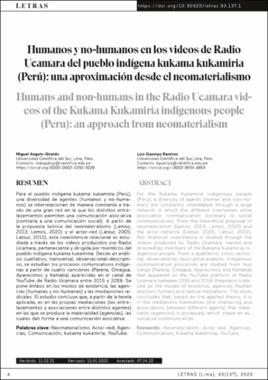
| dc.description.abstract | For the Kukama Kukamiria indigenous people (Peru), a diversity of agents (human and non-human) are constantly interrelated through a large network in which the different intertwines allow associative communication (contrary to social communication). From the theoretical proposal of neomaterialism (Lemos, 2013; Lemos, 2020) and the actor-network (Latour, 2005; Latour, 2012), this relational coexistence is studied through the videos produced by Radio Ucamara, owned and directed by members of the Kukama Kukamiria indigenous people. From a qualitative, cross-sectional, observational-descriptive analysis, indigenous communication processes are studied from four songs (Parana, Omagua, Aparecimos and Kamatia) that appeared on the YouTube platform of Radio Ucamara between 2015 and 2019. Emphasis is placed on the modes of existence, agencies (human and non-human) and radical mediations. The study concludes that, based on the applied theory, it is in the mediations themselves (the interlacing and associations between different agents) that materiality (agencies) is produced, which shape an associative communication. | en_US |
| dc.description.abstract | Para el pueblo indígena kukama kukamiria (Perú), una diversidad de agentes (humanos y no-humanos) se interrelacionan de manera constante a través de una gran red en la que los distintos entrelazamientos permiten una comunicación asociativa (contraria a una comunicación social). A partir de la propuesta teórica del neomaterialismo (Lemos, 2013; Lemos, 2020) y el actor-red (Latour, 2005; Latour, 2012), esta coexistencia relacional es estudiada a través de los videos producidos por Radio Ucamara, perteneciente y dirigida por miembros del pueblo indígena kukama kukamiria. Desde un análisis cualitativo, transversal, observacional-descriptivo, se estudian los procesos comunicativos indígenas a partir de cuatro canciones (Parana, Omagua, Aparecimos y Kamatia) aparecidas en el canal de YouTube de Radio Ucamara entre 2015 y 2019. Se pone énfasis en los modos de existencia, las agencias (humanas y no-humanas) y las mediaciones radicales. El estudio concluye que, a partir de la teoría aplicada, es en las propias mediaciones (los entrelazamientos y asociaciones entre distintos agentes) en las que se produce la materialidad (agencias), las cuales dan forma a una comunicación asociativa. | es_PE |
| dc.format | application/pdf | |
| dc.language.iso | spa | |
| dc.publisher | Facultad de Letras y Ciencias Humanas, Universidad Nacional Mayor de San Marcos | |
| dc.relation.ispartof | urn:issn:2071-5072 | |
| dc.rights | https://purl.org/coar/access_right/c_abf2 | |
| dc.rights.uri | https://creativecommons.org/licenses/by-nc-sa/4.0/ | |
| dc.subject | Cultural Heritage and Archaeology in Amazonia and beyond | en_US |
| dc.subject | Indigenous Perspectives on Ritual and Identity in Amazonia | en_US |
| dc.title | Humanos y no-humanos en los videos de Radio Ucamara del pueblo indígena kukama kukamiria (Perú): una aproximación desde el neomaterialismo | es_PE |
| dc.title.alternative | Humans and non-humans in the Radio Ucamara videos of the Kukama Kukamiria indigenous people (Peru): an approach from neomaterialism | en_US |
| dc.type | https://purl.org/coar/resource_type/c_b239 | |
| dc.subject.ocde | https://purl.org/pe-repo/ocde/ford#6.03.00 | |
| dc.type.other | Editorial | |
| dc.identifier.journal | Letras (Peru) | |
| dc.type.version | https://purl.org/coar/version/c_970fb48d4fbd8a85 |
Files in this item
This item appears in the following Collection(s)
-
Editorial [44]

Except where otherwise noted, this item's license is described as https://purl.org/coar/access_right/c_abf2