Closed Incision Negative Pressure Therapy in Oncoplastic Breast Surgery: A Comparison of Outcomes
| dc.contributor.author | Wareham, C.M. | |
| dc.contributor.author | Karamchandani, M.M. | |
| dc.contributor.author | Ku, G.D.L.C. | |
| dc.contributor.author | Gaffney, K. | |
| dc.contributor.author | Sekigami, Y. | |
| dc.contributor.author | Persing, S.M. | |
| dc.contributor.author | Homsy, C. | |
| dc.contributor.author | Nardello, S. | |
| dc.contributor.author | Chatterjee, A. | |
| dc.date.accessioned | 2025-10-31T18:32:25Z | |
| dc.date.available | 2025-10-31T18:32:25Z | |
| dc.date.issued | 2023 | |
| dc.identifier.uri | https://hdl.handle.net/20.500.12805/4631 | |
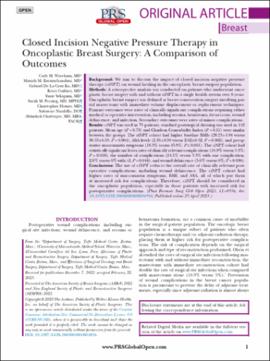
| dc.description.abstract | Background: We aim to discern the impact of closed incision negative pressure therapy (ciNPT) on wound healing in the oncoplastic breast surgery population. Methods: A retrospective analysis was conducted on patients who underwent oncoplastic breast surgery with and without ciNPT in a single health system over 6 years. Oncoplastic breast surgery was defined as breast conservation surgery involving partial mastectomy with immediate volume displacement or replacement techniques. Primary outcomes were rates of clinically significant complications requiring either medical or operative intervention, including seroma, hematoma, fat necrosis, wound dehiscence, and infection. Secondary outcomes were rates of minor complications. Results: ciNPT was used in 75 patients; standard postsurgical dressing was used in 142 patients. Mean age (P = 0.73) and Charlson Comorbidity Index (P = 0.11) were similar between the groups. The ciNPT cohort had higher baseline BMIs (28.23 ± 4.94 versus 30.55 ± 6.53; P = 0.004), ASA levels (2.35 ± 0.59 versus 2.62 ± 0.52; P = 0.002), and preoperative macromastia symptoms (18.3% versus 45.9%; P ≤ 0.001). The ciNPT cohort had statistically significant lower rates of clinically relevant complications (16.9% versus 5.3%; P = 0.016), the number of complications (14.1% versus 5.3% with one complication, 2.8% versus 0% with >2; P = 0.044), and wound dehiscence (5.6% versus 0%; P = 0.036). Conclusions: The use of ciNPT reduces the overall rate of clinically relevant postoperative complications, including wound dehiscence. The ciNPT cohort had higher rates of macromastia symptoms, BMI, and ASA, all of which put them at increased risk for complications. Therefore, ciNPT should be considered in the oncoplastic population, especially in those patients with increased risk for postoperative complications. | en_US |
| dc.format | application/pdf | |
| dc.language.iso | eng | |
| dc.publisher | Lippincott Williams and Wilkins | |
| dc.relation.ispartof | urn:issn:2169-7574 | |
| dc.rights | https://purl.org/coar/access_right/c_abf2 | |
| dc.rights.uri | https://creativecommons.org/licenses/by-nc-sa/4.0/ | |
| dc.subject | Facial Nerve Innovations in Surgical Techniques | en_US |
| dc.subject | Negative Pressure Therapy in Wound Management | en_US |
| dc.title | Closed Incision Negative Pressure Therapy in Oncoplastic Breast Surgery: A Comparison of Outcomes | en_US |
| dc.type | https://purl.org/coar/resource_type/c_5794 | |
| dc.identifier.doi | https://doi.org/10.1097/GOX.0000000000004936 | |
| dc.subject.ocde | https://purl.org/pe-repo/ocde/ford#3.02.11 | |
| dc.type.other | Conference Paper | |
| dc.identifier.journal | Plastic and Reconstructive Surgery - Global Open | |
| dc.type.version | https://purl.org/coar/version/c_970fb48d4fbd8a85 |
Files in this item
This item appears in the following Collection(s)

Except where otherwise noted, this item's license is described as https://purl.org/coar/access_right/c_abf2