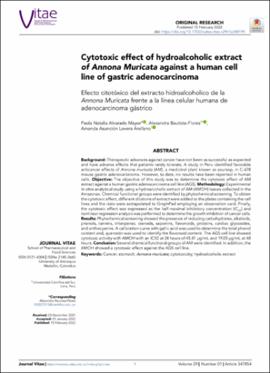
Cytotoxic effect of hydroalcoholic extract of Annona Muricata against a human cell line of gastric adenocarcinoma
| dc.contributor.author | Mayor, P.N.A. | |
| dc.contributor.author | Bautista-Flores, A. | |
| dc.contributor.author | Arellano, A.A.L. | |
| dc.date.accessioned | 2025-10-31T18:32:18Z | |
| dc.date.available | 2025-10-31T18:32:18Z | |
| dc.date.issued | 2022 | |
| dc.identifier.uri | https://hdl.handle.net/20.500.12805/4578 | |
| dc.description.abstract | Background: Therapeutic advances against cancer have not been as successful as expected and have adverse effects that patients rarely tolerate. A study in Peru identified favorable anticancer effects of Annona muricata (AM), a medicinal plant known as soursop, in C-678 mouse gastric adenocarcinoma. However, to date, no results have been reported in human cells. Objective: The objective of this study was to determine the cytotoxic effect of AM extract against a human gastric adenocarcinoma cell line (AGS). Methodology: Experimental in vitro analytical study using a hydroalcoholic extract of AM (AMOH) leaves collected in the Amazonas. Chemical functional groups were identified by phytochemical screening. To obtain the cytotoxic effect, different dilutions of extract were added to the plates containing the cell lines and the data were extrapolated to GraphPad employing an observation card. Finally, the cytotoxic effect was expressed as the half-maximal inhibitory concentration (IC<inf>50</inf>) and nonlinear regression analysis was performed to determine the growth inhibition of cancer cells. Results: Phytochemical screening showed the presence of reducing carbohydrates, alkaloids, phenols, tannins, triterpenes, steroids, saponins, flavonoids, proteins, cardiac glycosides, and anthocyanins. A calibration curve with gallic acid was used to determine the total phenol content and, quercetin was used to identify the flavonoid content. The AGS cell line showed cytotoxic activity with AMOH with an IC50 at 24 hours of 45.81 µg/mL and 19.05 µg/mL at 48 hours. Conclusion: Several chemical functional groups of AM were identified. In addition, the AMOH showed a cytotoxic effect against the AGS cell line. | en_US |
| dc.description.sponsorship | We thank the cell culture and natural product laboratory of the Universidad Científica del Sur, and especially Dr. Ana Mayanga Herrera, Salyoc Tapia Rojas, and Roxana Ramos Aramburu who supported us in carrying out the project. | |
| dc.format | application/pdf | |
| dc.language.iso | eng | |
| dc.publisher | Universidad de Antioquía | |
| dc.relation.ispartof | urn:issn:0121-4004 | |
| dc.rights | https://purl.org/coar/access_right/c_abf2 | |
| dc.rights.uri | https://creativecommons.org/licenses/by-nc-sa/4.0/ | |
| dc.subject | SDG 3 | en_US |
| dc.subject | Antioxidant Compounds and Their Medicinal Potential | en_US |
| dc.subject | Anticancer and Antioxidant Properties of Annona Muricata | en_US |
| dc.title | Cytotoxic effect of hydroalcoholic extract of Annona Muricata against a human cell line of gastric adenocarcinoma | en_US |
| dc.title.alternative | Efecto citotóxico del extracto hidroalcoholico de la Annona Muricata frente a la línea celular humana de adenocarcinoma gástrico | es_PE |
| dc.type | https://purl.org/coar/resource_type/c_0857 | |
| dc.identifier.doi | https://doi.org/10.17533/udea.vitae.v29n1a348194 | |
| dc.subject.ocde | https://purl.org/pe-repo/ocde/ford#3.02.21 | |
| dc.type.other | Communication letter o Case Report | |
| dc.identifier.journal | Vitae | |
| dc.type.version | https://purl.org/coar/version/c_970fb48d4fbd8a85 |
Files in this item
This item appears in the following Collection(s)

Except where otherwise noted, this item's license is described as https://purl.org/coar/access_right/c_abf2