Depresión y violencia conyugal en gestantes peruanas durante la pandemia por la COVID-19
| dc.contributor.author | Medina Quispe, C.I. | |
| dc.contributor.author | Quispe Huamani, Y.N. | |
| dc.contributor.author | Linares, A. | |
| dc.contributor.author | Huaccho-Rojas, J. | |
| dc.date.accessioned | 2025-10-31T18:32:16Z | |
| dc.date.available | 2025-10-31T18:32:16Z | |
| dc.date.issued | 2022 | |
| dc.identifier.uri | https://hdl.handle.net/20.500.12805/4562 | |
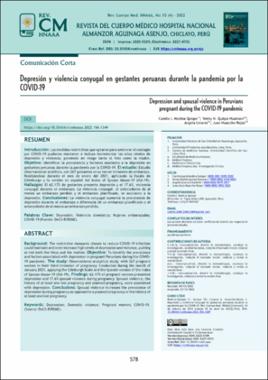
| dc.description.abstract | Background: The restrictive measures chosen to reduce COVID-19 infection could maintain and even increase high levels of depression and violence, putting at risk both the fetus and the mother. Objective: To identify the prevalence and factors associated with depression in pregnant Peruvians during the COVID-19 pandemic. The study: Observational-analytical study, with 267 pregnant women in their third trimester of pregnancy. Conducted during the month of January 2021, applying the Edinburgh Scale and the Spanish version of the Index of Spouse Abuse-19 (ISA-19). Findings: 62.17% of pregnant women presented depression and 17.6% spousal violence during pregnancy. Spousal violence, the history of at least one lost pregnancy and planned pregnancy, were associated with depression. Conclusions: Spousal violence increases the prevalence of depression during pregnancy as opposed to a planned pregnancy or the history of at least one lost pregnancy. | en_US |
| dc.description.abstract | Introducción: Las medidas restrictivas que optaron para aminorar el contagio por COVID-19 pudieron mantener e incluso incrementar los altos niveles de depresión y violencia, poniendo en riesgo tanto al feto como la madre. Objetivo: Identificar la prevalencia y factores asociados a la depresión en gestantes peruanas durante la pandemia por la COVID-19. El estudio: Estudio observacional-analítico, con 267 gestantes en su tercer trimestre de embarazo. Realizándose durante el mes de enero del 2021, aplicando la Escala de Edimburgo y la versión en español del Index of Spouse Abuse-19 (ISA-19). Hallazgos: El 62.17% de gestantes presento depresión y el 17.6%, violencia conyugal durante el embarazo. La violencia conyugal, el antecedente de al menos un embarazo perdido y el embarazo planificado, se asociaron a la depresión. Conclusiones: La violencia conyugal aumenta la prevalencia de depresión durante el embarazo a diferencia de un embarazo planificado o el antecedente de al menos un embarazo perdido. | es_PE |
| dc.format | application/pdf | |
| dc.language.iso | spa | |
| dc.publisher | Medical Body of the Almanzor Aguinaga Asenjo National Hospital | |
| dc.relation.ispartof | urn:issn:2227-4731 | |
| dc.rights | https://purl.org/coar/access_right/c_abf2 | |
| dc.rights.uri | https://creativecommons.org/licenses/by-nc-sa/4.0/ | |
| dc.subject | SDG 5 | en_US |
| dc.subject | SDG 16 | en_US |
| dc.subject | ADHD and Associated Neuropsychiatric Disorders | en_US |
| dc.subject | Vigilance Regulation and Brain Arousal in Disorders | en_US |
| dc.title | Depresión y violencia conyugal en gestantes peruanas durante la pandemia por la COVID-19 | es_PE |
| dc.title.alternative | Depression and spousal violence in Peruvians pregnant during the COVID-19 pandemic | en_US |
| dc.type | https://purl.org/coar/resource_type/c_0857 | |
| dc.identifier.doi | https://doi.org/10.35434/rcmhnaaa.2022.154.1349 | |
| dc.subject.ocde | https://purl.org/pe-repo/ocde/ford#5.01.00 | |
| dc.type.other | Communication letter o Case Report | |
| dc.identifier.journal | Revista del Cuerpo Medico Hospital Nacional Almanzor Aguinaga Asenjo | |
| dc.type.version | https://purl.org/coar/version/c_970fb48d4fbd8a85 |
Files in this item
This item appears in the following Collection(s)

Except where otherwise noted, this item's license is described as https://purl.org/coar/access_right/c_abf2