La investigación científica es deficiente entre residentes de nefrología: el caso peruano
| dc.contributor.author | Herrera-Anazco, P. | |
| dc.contributor.author | Mezones-Holguin, E. | |
| dc.contributor.author | Hernandez, A.V. | |
| dc.date.accessioned | 2025-10-31T18:32:16Z | |
| dc.date.available | 2025-10-31T18:32:16Z | |
| dc.date.issued | 2014 | |
| dc.identifier.uri | https://www.scielo.org.ar/scielo.php?script=sci_arttext&pid=S2346-85482014000300007 | |
| dc.identifier.uri | https://hdl.handle.net/20.500.12805/4560 | |
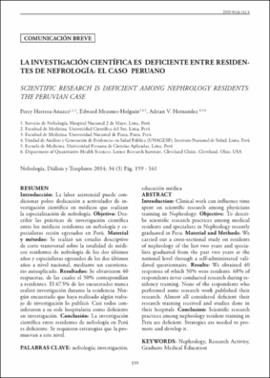
| dc.description.abstract | Introduction: Clinical work can influence time spent on scientific research among physicians training in Nephrology. Objective: To describe scientific research practices among medical residents and specialists in Nephrology recently graduated in Peru. Material and Methods: We carried out a cross-sectional study on residents of nephrology of the last two years and specialists graduated from the past two years at the national level through a self-administered validated questionnaire. Results: We obtained 40 responses of which 50% were residents. 68% of respondents never conducted research during residency training. None of the respondents who performed some research work published their research. Almost all considered deficient their research training received and studies done in their hospitals. Conclusion: Scientific research practices among nephrology resident training in Peru are deficient. Strategies are needed to promote and develop it. | en_US |
| dc.description.abstract | Introducción: La labor asistencial puede condicionar pobre dedicación a actividades de investigación científica en médicos que realizan la especialización de nefrología. Objetivo: Describir las prácticas de investigación científica entre los médicos residentes en nefrología y especialistas recién egresados en Perú. Material y métodos: Se realizó un estudio descriptivo de corte transversal sobre la totalidad de médicos residentes de nefrología de los dos últimos años y especialistas egresados de los dos últimos años a nivel nacional, mediante un cuestionario autoaplicado. Resultados: Se obtuvieron 40 respuestas, de las cuales el 50% correspondían a residentes. El 67.5% de los encuestados nunca realizó investigación durante la residencia. Ningún encuestado que haya realizado algún trabajo de investigación lo publicó. Casi todos consideraron a su sede hospitalaria como deficiente en investigación. Conclusión: La investigación científica entre residentes de nefrología en Perú es deficiente. Se requieren estrategias que la promuevan a este nivel. | es_PE |
| dc.format | application/pdf | |
| dc.language.iso | spa | |
| dc.publisher | Asociación Regional de Diálisis y Transplantes Renales de Capital Federal y Provincia de Buenos Aires | |
| dc.relation.ispartof | urn:issn:2346-8548 | |
| dc.rights | https://purl.org/coar/access_right/c_abf2 | |
| dc.rights.uri | https://creativecommons.org/licenses/by-nc-sa/4.0/ | |
| dc.subject | SDG 3 | en_US |
| dc.subject | Peer Review Dynamics in Biomedical Research Networks | en_US |
| dc.subject | Enhancing Medical Research Careers through Training Programs | en_US |
| dc.title | La investigación científica es deficiente entre residentes de nefrología: el caso peruano | es_PE |
| dc.title.alternative | Scientific research is deficient among nephrology residents: The peruvian case | en_US |
| dc.type | https://purl.org/coar/resource_type/c_0857 | |
| dc.subject.ocde | https://purl.org/pe-repo/ocde/ford#3.02.00 | |
| dc.type.other | Communication letter o Case Report | |
| dc.identifier.journal | Revista de Nefrologia, Dialisis y Trasplante | |
| dc.type.version | https://purl.org/coar/version/c_970fb48d4fbd8a85 |
Files in this item
This item appears in the following Collection(s)

Except where otherwise noted, this item's license is described as https://purl.org/coar/access_right/c_abf2