El discurso político de nación y patria en la prensa durante el proceso de independencia del Perú (1821-1822)
| dc.contributor.author | Angulo Giraldo, M.Á. | |
| dc.contributor.author | Morán Ramos, L.D. | |
| dc.date.accessioned | 2025-10-31T18:32:12Z | |
| dc.date.available | 2025-10-31T18:32:12Z | |
| dc.date.issued | 2022 | |
| dc.identifier.uri | https://www.scielo.org.mx/scielo.php?script=sci_arttext&pid=S1870-719X2022000200079 | |
| dc.identifier.uri | https://hdl.handle.net/20.500.12805/4522 | |
| dc.description.abstract | The article analyzes the discursive constructions that show the configuration of a macro-identity of the Peruvian homeland or nation in the context of the crisis of the final period of the Viceroyalty of Peru in four of Lima’s newspapers that represented some of the dominant political positions: a loyal envisioned newspaper like El Triunfo de la Nación; another with a patriotic position and favorable to the constitutional monarchy, such as Los Andes Libres, whose continuation was the Correo Mercantil Politico y Literario; and a pro-independence and republican newspaper such as La Abeja Republicana. The research maintains that the discursive construction of patriotism started from a purely emotional and affective consideration, in which passion stood out as a guide to that feeling; however, this patriotism could only be guided by the abstract idea of a nation (a territory, a population and an idea) with which the citizens of the arising Peruvian republic should feel identified. | en_US |
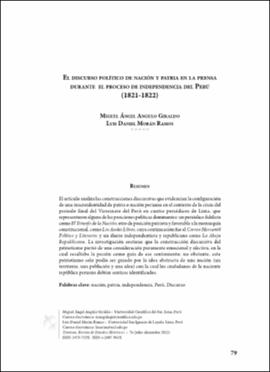
| dc.description.abstract | El artículo analiza las construcciones discursivas que evidencian la configuración de una macroidentidad de patria o nación peruana en el contexto de la crisis del periodo final del Virreinato del Perú en cuatro periódicos de Lima, que representaron alguna de las posiciones políticas dominantes: un periódico fidelista como El Triunfo de la Nación; otro de posición patriota y favorable a la monarquía constitucional, como Los Andes Libres, cuya continuación fue el Correo Mercantil Político y Literario; y un diario independentista y republicano como La Abeja Republicana. La investigación sostiene que la construcción discursiva del patriotismo partió de una consideración puramente emocional y afectiva, en la cual resaltaba la pasión como guía de ese sentimiento; no obstante, este patriotismo solo podía ser guiado por la idea abstracta de una nación (un territorio, una población y una idea) con la cual los ciudadanos de la naciente república peruana debían sentirse identificados. | es_PE |
| dc.format | application/pdf | |
| dc.language.iso | spa | |
| dc.publisher | Instituto de Investigaciones Históricas, Universidad Michoacana | |
| dc.relation.ispartof | urn:issn:1870-719X | |
| dc.rights | https://purl.org/coar/access_right/c_abf2 | |
| dc.rights.uri | https://creativecommons.org/licenses/by-nc-sa/4.0/ | |
| dc.subject | Cultural Dynamics and Social Integration in Latin America | en_US |
| dc.subject | Political Dynamics and Independence in Nineteenth Century Peru | en_US |
| dc.title | El discurso político de nación y patria en la prensa durante el proceso de independencia del Perú (1821-1822) | es_PE |
| dc.title.alternative | THE POLITICAL DISCOURSE OF NATION AND COUNTRY IN THE PRESS OF THE INDEPENDENCE PROCESS OF PERU (1821-1822) | en_US |
| dc.type | https://purl.org/coar/resource_type/D97F-VB57 | |
| dc.subject.ocde | https://purl.org/pe-repo/ocde/ford#6.01.01 | |
| dc.type.other | Commentary, Perspective u Opinion | |
| dc.identifier.journal | Tzintzun | |
| dc.type.version | https://purl.org/coar/version/c_970fb48d4fbd8a85 |
Files in this item
This item appears in the following Collection(s)

Except where otherwise noted, this item's license is described as https://purl.org/coar/access_right/c_abf2